
- ボラ協を知る
- ボランティアする・募る
-
ボランティアする
はじめての方はこちら 説明会に参加する 募集情報を探す ボランティア体験する 個別に相談する -
ボラ協でボランティアする
協会のボランティアスタッフになるボランティアの応援を求める
個人の方へ 施設・団体の方へ -
ボランティア募集情報掲載サイト
ボランティアスタイル KVnet
-
- 学ぶ・深める
-
講座・学習会
講座・学習会 一覧調査・研究・政策提言
調査・研究データを見る ボランタリズム研究所 裁判員ACT -
出版・図書
市民活動総合情報誌「ウォロ」 ボラ協の発行書籍 ライブラリー蔵書の貸出災害支援
災害・防災の取り組み -
情報誌ウォロ最新号
2022年2月・3月号
-
- 寄付する・会員になる
 寄付・寄贈する
 寄付する
寄付する 会員になる
会員になるトップページ
Osaka Voluntary Action Center
寄付する・会員になる
ボラ協を知る
ボラ協を知る
大阪ボランティア協会について 3分でわかるボラ協 ボラ協を支える人たち 参加型運営 委員会・チーム紹介 ボラ協の歴史団体情報
団体概要・アクセス 役員・評議員 情報公開団体情報
ボラ協のオピニオン―V時評―ボランティアする・募る
ボランティアする
はじめての方はこちら 説明会に参加する 募集情報を探す ボランティア体験する 個別に相談するボラ協でボランティアする
協会のボランティアスタッフになるボランティアの応援を求める
個人の方へ 施設・団体の方へボランティア募集情報掲載サイト
ボランティアスタイル KVnet学ぶ・深める
講座・学習会
はじめての方はこちら調査・研究・政策提言
調査・研究データを見る ボランタリズム研究所 裁判員ACT出版・図書
市民活動総合情報誌「ウォロ」 ボラ協の発行書籍 ライブラリー蔵書の貸出情報誌ウォロ最新号
2022年2月・3月号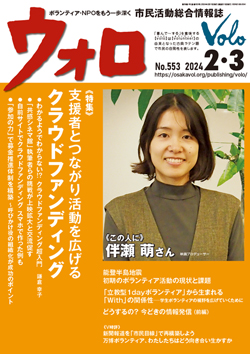
Welcome to Osaka Voluntary Action Center Website!
Osaka Voluntary Action Center (OVAC) is a non-profit organization (NPO) founded in 1965, which was set up under the mission of promoting volunteerism in Osaka and Kansai area. (Our history)
OVAC has been striving to encourage, support, and motivate citizens to tackle various social issues. In the process we have constructed our comprehensive functions to energize civil activities. We provide networking opportunities for volunteers and NPOs, investigate current topics of volunteer activities and conduct research on how to strengthen NPOs.
**If you would like to know and explore OVAC’s activities or its history, there are a few steps to take. Visit this page to learn more about a formal visit request.
Our Activities - What does OVAC do?
No.1
Volounteer Coordination
- Provides information about volunteer activities and NPOs to people who are interested in volunteering via telephone, on the Internet or in person.
Firstly, please take time and read the Volunteer Checkpoint and Volunteer Guidebook to familiarize yourself with the basics of volunteering.
→Next, visit KVnet database about volunteer recruitments (Japanese only).
*We provide this service for person living and currently staying in Kansai Area.
- Offering volunteer insurance in case of accidents.
Are you struggling to find what volunteer to participate?
What kind of volunteer activities
would you want to participate in?
You may discover what you are interested in and what type of volunteer you want to participate in through this platform.
**Although a lot of volunteer recruitments are in Japanese, there are a few volunteers you can do with English only.
After reading this checkpoint, visit KVnet database about volunteer recruitments in Japanese, click here.
Most of the programs in KVnet often require participants to have a certain level of speaking, listening, and understanding Japanese in order to provide accurate instructions. We are sorry for this inconvenience, and thank you for your understanding.
→Before you apply for a volunteer or you participate in a volunteer, please take time and read Volunteer Guidebook to get ready for your new volunteering experience in Japan! This is useful especially if you are worried about Japanese culture and different customs from your originating country.
Attention
It is always helpful if you know how to greet people in Japanese, to have even a simple conversation in Japanese, or to say some basic words and phrases in Japanese. It does not have to be perfect because a lot of people around you will definitely try to understand you!
What is your interest?
-
Bring out the possibility of children
-
- Interact with children who refuse to go to school or who are withdrawn
- Plan camping and support its management
- Make use of your hobby and speciality through sport clubs and music activities
- Support child raising
Advice
There is not a language barrier when you interact with people through your hobby or through something you like! However, this type of volunteer is often long-term in order to build a strong relationship.
-
Enrich the lives of the elderly people and people with disabilities
-
- Be involved in conversations and spend leisure time together, as well as support outings
- Support para-sports
- Visit nursing homes
- Braille, create magnified books, sign language translator, or write down summaries
Advice
Similar to an interaction with children, there is not a language barrier in communication with them. It is more important that you are willing to have a conversation with them!
-
Conserve and raise the nature and an environment
-
- Participate in cleaning up and picking up the garbage
- Participate in Satoyama conservation activities
- Observe the nature
- Recycle
- Consider food miles
Advice
If you feel anxious about talking to people in Japanese, this volunteer type might be easier to participate in! Volunteers related to an environmental issues overall or nature conservation do not often require communication among participants.
-
Deepen an understanding of diversity
-
- Participate in educational support in Japanese language school
- Support the translation
- Participate in international exchange association
- Buy fair trade products
Recommendation
Participate in Japanese Class (scroll down to see a list in different languages): Osaka City Board of Education creates a space for non-Japanese speakers to interact with Japanese speakers. Through learning Japanese, learners are able to exchange their own cultures. Consider attending Japanese language center to learn more Japanese!
Attention
This type of volunteering requires you to have a certain level of Japanese because this is to support non-Japanese speakers to learn Japanese. Even though there is a staff member who speaks your language and supports you, you may want to look into other types of volunteer if you do not speak Japanese.
-
Join hospitals and medical situations
-
- Guide at the hospital reception
- Making clothes and items that are easy to use for hospitalized patients who are having a hard time doing daily activities
- Work at the library in the hospital
- Read a picture book to children who are on long-term care
-
Create a connection through cultures and arts
-
- Plan and manage an event at a museum, an art museum, a zoo, and an aquarium
- Volunteer at the music event
- Offer information through art
- Conserve traditions
- Introduce a new culture
-
Support homeless people
-
- Participate in providing warm meal service
- Watching over homeless people to make sure they are fine
- Plan an event for people to confront poverty issue
-
Support civil activities through IT
-
- Become a supporter to deal with computer
- Create a webpage for voluntary group
- Volunteer for office work
- Support those who are disabled
-
Protect and raise animals
-
- Participate in animal protection group (help raising animals or enlightening activities)
- Donate necessities such as food
- Raise guide dogs
- Become a foster parent
-
Be involved in volunteers after natural disasters
-
- Work for reconstruction assistance
- Visit the victims
- Create a map for disaster prevention
-
Work on community development with locals
-
- Conserve traditional housings and towns that have a significant history
- Be involved in an activation of shopping streets
- Participate in local festivals
- Help snow shoveling for elderly people or for those who are struggling to do
Advice
This is a great opportunity for you to get involved in Japanese culture, history, and traditions, in addition to an interaction with local people.
-
Think about the gender
-
- Learn about the gender with children
- Spread an awareness of sexual minorities (such as lesbian, gay, transgender)
- Participate in events related to the gender issue
Advice
We think that this topic is not argued as often as it is in other countries, and an awareness towards gender and minority issues are just starting to be spread among people in Japan.
-
Connect through collect-send-activities
-
- Participate in fundraising activities
- Donate toys, stationeries, instruments
- Send used postage stamps
- Send unused postcards and miss-writing postcards
- Send clothings
-
Be considerate of someone’s mind
-
- Support self-help group
- Participate in support group for criminal victims
- Listen to others
- Participate in tele-consultation
-
Watch over children in an educational setting
-
- Support classes
- Keep an eye on children during their way to and from school
- Support an after-school program for working parents
When you first do a volunteer in Japan, you may feel excited and nervous, starting to think,“What do I have to prepare?” or “What is something I have to be careful when volunteering?”. If you know what to be careful, it will make you feel less anxious about your first experience of volunteering. Please check this out!
-
1What are the risks during the volunteer?
-
There is always a risk whenever people try to do something. It is the same for volunteering. For example, you might be late for the volunteer because of the delay of the transportation, or you might hurt or injure someone during the volunteer… Therefore, it is important to make sure what you do for the volunteer and where you volunteer, as well as how to deal with an emergent problem. Furthermore, there is a “volunteer insurance” that has an insurance for accidents during the volunteer or accidents while you transport. You may want to check it in with an organization you are volunteering for.
-
2How to choose the volunteer (basic attitudes)?
-
Volunteering is not just for your convenience, however, it is formed after an agreement between “what I want to do and can do” and “what the other person wants or needs”. Anybody can participate in volunteering, and it is most important to discuss and come to an agreement with what you want to do and can do, what the other person wants from you, what you actually do, and your thoughts, with people you are working with.
-
3Clothes to wear for the volunteer
-
It is ideal to wear something comfortable to move around. However, choosing too casual clothes might be inappropriate depending on where you do the volunteer at, therefore, considering what would be appropriate for a certain situation. It is essential to consider where you are going to do a volunteer and what kind of volunteer you are working for. For example in the case of physical assistance volunteer, long nails, a ring or a brooch with a projection, or an ornament such as long necklace would cause a harm on someone you are helping.
-
4What is the cost that you are responsible for the volunteer?
-
As a principle, volunteers need to be done without any reward. However, in order to decrease the responsibility of volunteers and get more participants, several organizations may cover the required fee to volunteer (such as a transportation fee, food, and ingredients). You will be able to participate comfortably if you make sure these points beforehand.
-
5Activity time and confidentiality
-
It is necessary to be punctual even if volunteers are voluntary activities. Volunteer activities are made up based on trust, therefore, it is essential to be on time and keep a promise. At the same time, it is never allowed to excessively tell others about what you saw or heard from the volunteer. These days, posting texts, photos, and videos on blogs, the internet, social media, and SNS is getting easier and more accessible. As well as the contact information of those who are involved in the volunteer, the other private information you get during the volunteer should be protected.
-
6What is the satisfaction level of people you volunteered for?
-
During the volunteer, you may get into the false idea that you are doing something good for someone, but the person does not perceive your favor the same way. People who are helped often feel sorry, and people who are helping often feel they should be appreciated. Therefore, you may feel, “why are people not happy even though I am helping them out?” In that case, always remember that volunteers have an equal relationship with people you are working for. Always try to put yourself in someone’s shoes while you volunteer.
-
7What would you do when you try too hard?
-
There could be a situation where you feel mentally and physically exhausted because you accept too much work. When you have more and more willingness, you put yourself in the other person’s shoes too much and forget to take care of yourself… If this happens, the volunteer will not be fun, you will have health problems, and other people will need to take care of you. In order to do a long-term volunteering with some fun, it is important to communicate “what you can do” and “what you cannot do”, and start from what you can do.
-
8What would you do when you struggle?
-
There are “volunteer coordinators” who are professional in consulting with volunteering. They are in volunteer centers, institutions, or organizations. At institutions and organizations, they may have other work as well or they are called “person in charge of volunteering”, and their position or the job name may differ. If you have anything in your mind about the volunteering, consult with a volunteer coordinator of the organization you are working with or of the nearest volunteer center. *People who speak other languages than Japanese are limited and sometimes volunteer centers do have a limited number of people or language.
No.2
Support & Consultation
- Providing meeting facilities as well as access to office equipment.
- Providing consultation regarding group management.
- Providing a wide range of support for building and strengthening organizational infrastructure.
- Giving clients advice on their projects.
- Conducting liaisons with grant-making agencies.
No.3
Citizenship Education
- Organizing a wide variety of learning opportunities for citizens.
No.4
Information
- Publishing a bimonthly magazine “Volo”.
- Utilizing internet to provide activity information.
No.5
Research & Advocacy
- Serving as a think tank for research, analysis, advice, and commentary on civil activities.
- Practicing policy advocacy.
OVAC History
OVAC was established in 1965.Following is a very brief history.
| June, 1963 | Volunteer groups in Osaka City came together and started to have monthly coordination meetings. |
|---|---|
| November, 1965 | “Volunteer Association Osaka Bureau” was established as a non-official organization. “Volunteer Introductory Courses” was offered as the first volunteer course in Japan. ( Since then, we have been providing various training & educational course for volunteers.) |
| July, 1966 | Published the first volunteer magazine “Gekkan Volunteer” (monthly volunteer). |
| July, 1967 | Published specialized book &”Volunteer Service” and 3 other books. (Since then, we have been expanding our publication activities.) |
| June, 1969 | The status of the organization changed to the corporate Juridical person and was named “Osaka Voluntary Action Center”. |
| May, 1971 | Applied “Volunteer Staff Participation System” and OVAC members became the main operators of the organization. |
| May, 1973 | Started to provide volunteer information constantly through newspapers. |
| June, 1976 | Offered “Training Course for Volunteer Coordinators”. The first one in Japan. |
| July, 1984 | Offered short term experience program “Summer Volunteer Project” as the first experience course in Osaka ( Kansai ) Area. |
| October, 1991 | Established “Center for Corporate Citizenship” and started to work in partnership with companies and volunteer groups. |
| July, 1993 | The status of OVAC changed to a social welfare corporation. |
| August, 1994 | DDeveloped and launched a data base system called VIS(Volunteer Information System). |
| January, 1995 | Organized temporary support center “Citizen Groups for supporting victims of the Great Hanshin Earthquake”. |
| November, 1996 | Participated in the establishment of “Japan NPO Center” and sent a staff there. |
| July, 1999 | Established “Non-profit Resource Center “. |
| November, 2001 | Established the Steering Committee for Citizen Empowerment Center. |
| April ,2002 | Opened “Osaka NPO Plaza”. |
| January ,2003 | Redesigned the volunteer magazine and renamed it “Volo: Comprehensive Informational Magazine for Civil Activities”. |
| May ,2003 | Started a new volunteer information distribution website “KVNET”. |
| April ,2005 | Started “Kansai NPO Support Center Network”(KNN). |
| May ,2005 | Started “Kansai CSR Forum” which aims at expansion of CSR value among enterprises. |
| September ,2009 | Opened “Research for Voluntarism Institute”. |
| March ,2011 | Provided various support for the Great East Japan Earthquake. Held an event, called 3.11 from Kansai, which aims at helping the reconstruction of the Great East Japan Earthquake in March 2012. |
| March ,2013 | Closed “Osaka NPO Plaza”. |
| April ,2013 | Opened “Civil and Voluntary Action Square -CANVAS Tanimachi” |
| November ,2015 | Celebrated half a century anniversary. It has been 50 years since we started OVAC. |
NPO : Non-profit Organization
「市民主体」での運営にご支援・参加いただけませんか?
ボラ協の運営は「市民主体」です。
運営資金のうち、会費や事業収入、
寄付などの民間資金が半分以上であるのはその意志の現れです。
あなたも大阪ボランティア協会を通じて市民社会づくりに参加しませんか?
ボランティア活動や市民活動を支える私たちの活動に、一人でも多くの方が加わってくださることを願っています。